Let's Work Together

What next?
- 1.We will reach out to you within one business day to discuss the next steps.
- 2.In the meantime, please review our portfolio and Blog.
- 3.If necessary, we will sign the NDA and begin the project discussion.
- 4.Our software development experts will analyze your requirements and make recommendations on the best ways to bring your concept to life.
Software Development Company
Looking for expert custom software developers? At ZetaLogix, we build high-performing custom software for businesses that need more than just a standard solution. Whether it’s a complex enterprise platform or a simple single-page application, our team has extensive experience in developing custom software products.

What Is a Software Development Company?
Software, a term coined as a joke and not seen in print until the 1960s, has permeated our culture to the point where we no longer notice it. What it entailed was foreign to ‘earthlings' until 1955, when companies decided to offer software products and services.
Nowadays, almost anything that uses electricity contains software, either embedded in the device to make it "intelligent," or installed as software in mobile devices and computers.
Creating software entails identifying a need, designing the program, and testing it for bugs. These are the fundamental tasks carried out by software development firms.
What does a Software Development Company Do?
They create beneficial programs
A software product is a program, or a collection of programs, that performs a function that potential customers may find useful. A software development company frequently creates multiple products that perform complementary functions.
They develop digital problem-solving solutions
Although the processes and techniques may differ, most businesses strive to create solutions for their customers. These solutions could be full-fledged software for the general public or tailored to the specific needs of businesses and industries.
They create corporate systems and websites
Software companies create websites and even apps for various operating systems. Some software companies create corporate web-based systems to assist businesses in automating processes, increasing productivity, and facilitating workflow management.
They provide technical information
Many digital agencies provide clients with advice on software packages that aid in business development and customer relationship management. We investigate methods to boost your company's performance by optimizing your business-to-business and end-user analysis.
WordPress & CMS Migration
WordPress migration is a difficult task, but it can be made easier. You can quickly change your site to a new host with no data loss. We specialize in streamlining the content creation process for updating your website. Create an easy-to-manage and standards-compliant website.
They provide business intelligence
Most software companies have extensive experience in providing data, analytical reports, dashboards, Online Analytical Processing (OLAP) solutions, and other data science services to businesses.
How to Choose a Software Development Company
Popular names or brands do not always count when it comes to selecting excellent software companies, whether to use their services or simply to learn about them. Here are a few nuggets to tell a software development company that knows what's best for your business:
Client-Centric Goals
A good software development company's primary goal is to please its clients, and it tailors its work culture to that end.
Transparent Communication
The development company carries its customers along by communicating with them and incorporating them into the development process.
Seamless Integration
A skilled software development team creates one-of-a-kind, efficient software that meets your specific needs and integrates seamlessly into your business.
Valuable Solutions
A great software development company offers truly valuable solutions. We are committed to meeting your needs through our team of highly skilled developers.
Our Software Development Approaches
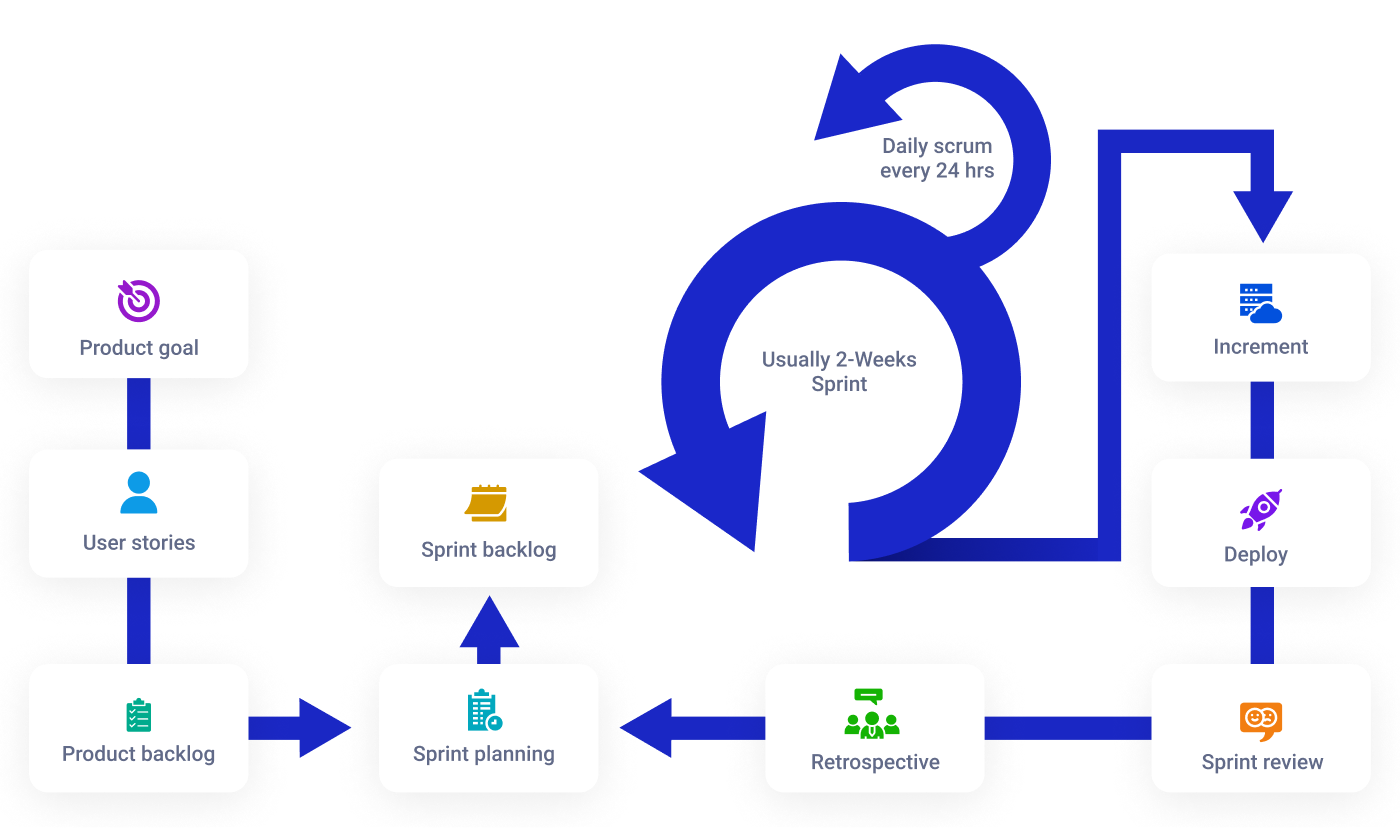
Our team follows the Agile-scrum and waterfall development methodologies. We’ve choosen both methodologies because of their various applicable scenarios which is solely dependent on your project type.
We strictly use the Agile-scrum methodology for businesses and startups looking to launch into their market as fast as possible, which will require us to produce an MVP (Minimum viable product).
Meanwhile we use the waterfall methodology for projects and business solutions that don’t necessarily prefer speed over quality; this means that we follow all stages of development serially from Research to final deployment.
Software Development Best Practices
Is there such a thing as an "ideal software development project," and if so, what steps should you take to get there? We compiled a list of some of our tried and true best practices that help software development projects run more smoothly:
Simplicity Of Code: Work Hard To Keep Your Code Simple
The goal is to eliminate unnecessary complexities in software development. The code simplification movement complements other software principles such as DRY (Don't Repeat Yourself), and YAGNI (You Aren't Gonna Need It).
Testing: Test Continuously From End To End
Test Driven Development (TDD) increases your confidence in the quality of your code. Full integration testing ensures that all components work as they should and increases code coverage.
Coherence In The Code: Remain Consistent About It On Your Team
It's critical to have a consistent style guide for your codebase when working with a team. There is no consistency between authors if you can tell who wrote a particular file in a codebase.
Reviews Of Codes: Check Your Code
It's a good idea to have a colleague read over your pull requests before merging them to ensure final code quality. The bottom line is that code reviews help reduce bugs in the product, so let go of the idea of perfection.
Estimate Your Time And Budget Realistically
A reasonable budget keeps your software project from feeling overburdened. This allows the scope to flex more easily as the project progresses with agile methods, but a truly off estimate can cause issues with quality, morale, and output.

Software Development Cycle
SDLC, or Software Development Life Cycle, is a series of steps used in the development of software applications. It is usually divided into six to eight steps: planning, requirements, design, build, documentation, testing, deployment, and maintenance. These steps break down the development process into tasks that can be assigned, completed, and measured.
Project Scoping & Leadership
Project leaders evaluate the project's terms during the Planning phase. This includes calculating labor and material costs, developing a timetable with target goals, and forming project teams, and establishing a leadership structure. The scope and purpose of the application should be clearly defined during planning.
Functional Specifications
Defining requirements is part of the planning process to determine what the application is supposed to do and what its requirements are. Defining the resources required to build the project is also part of the requirements.
Architecture & Interfaces
The Design phase simulates how a software application will function. Prototyping can be included in the design phase. It demonstrates a basic understanding of how the application appears and functions. This "hands-on" design can be demonstrated to stakeholders.
Writing the Code
This is the actual program writing. A small project may be written by a single developer, whereas a large project may be divided and worked on by multiple teams. Instructions and explanations are greatly appreciated by software developers. Documentation can be a formal process that includes creating an application user guide.
Quality Assurance
It is critical to test an application before releasing it to users. Different parts of the application should be tested to ensure that they work together seamlessly and eliminate any hangs or lags in processing.
Going Live
The application is made available to users during the deployment phase. Many businesses prefer to automate the deployment process. This can be as simple as putting a payment portal and a download link on the company's website.
Post-Launch Support
The development cycle is nearly complete at this point. The application has been completed and is being used in the field. However, the phase of operation and maintenance is still important.
.png)
Why Choose Us?
We believe in approaching each project as a potential game-changer, and as a result, we provide comprehensive support to our clients that extends far beyond the code. This approach, combined with an enthusiastic team, enables us to create the best custom product for your company.
We can create a software product of any scale and fully cover your needs in custom software application development because we have experienced business analysts, project managers, software developers, UX/UI designers, and QA engineers on board.
Our development process is efficient and transparent, allowing us to deliver your software on time and within budget. Our clients' success is our top priority. To ensure the best value, we carefully align your business requirements with software functionality.
Let's Work Together
What next?
- 1.We will reach out to you within one business day to discuss the next steps.
- 2.In the meantime, please review our portfolio and Blog.
- 3.If necessary, we will sign the NDA and begin the project discussion.
- 4.Our software development experts will analyze your requirements and make recommendations on the best ways to bring your concept to life.
Got a Project? Tell us about it!
Our engineering team is ready to transform your ideas into scalable reality.